More than 85 percent of the world’s energy comes from combustion. However, increasing energy demands and stricter emission regulations are introducing new challenges to the optimization of combustion processes. The Flame Design team, which involves investigators in the LACER lab as well as the University of Maryland (Peter Sunderland) and NASA (Dave Urban), is investigating how to improve our understanding of flames in order to reduce emissions. Emissions such as soot are responsible not only for thousands of deaths annually as well as reduced visibility in many U.S. cities, but also for increased global warming.
The focus of the Flame Design work is non-premixed flames, which are often used in energy production and transportation. In essence, this work is evaluating the relationship between the local temperature and the local gas composition — that is, the flame structure — and how that can be influenced by changing the composition of the fuel and oxidizer streams. We have shown that by changing the flame structure, we can produce non-premixed flames that are soot-free even at high flame temperatures.
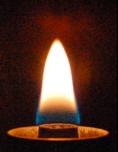
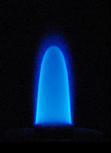
For example, compare the bright flame shown with the photo of the blue flame. The typical yellow flame that we observe is due to blackbody radiation from soot particles produced in the flame. But when the particles are absent the flame is blue, and this occurs when we modify the flame structure, even though that flame uses the same fuel and burns at the same temperature. We are working to understand how changing flame structure influences the chemistry of soot precursor formation and thereby leads to soot-free flames at long residence times — that is, to permanently blue flames.
We have recently proposed using the carbon-to-oxygen atom ratio as a variable to characterize flame structure. Our numerical and experimental studies have shown that the C/O atom ratio is a direct and convenient variable for understanding flame characteristics like soot inception and radical behavior, regardless of strain rate and boundary conditions. That makes it easier to grasp fundamental combustion characteristics, and to gain a greater understanding of flame structure and its effects on flame properties.
Current Flame Design research in LACER is focused on numerically analyzing the flame structure in C/O atom ratio space, as well as on developing methods for direct measurement of atomic ratios.