
Single-walled carbon nanotubes (SWNTs) possess many unique electrical and mechanical properties. They can be conducting, semiconducting or insulating, based on their chirality. They also have a high surface area and a high strength-to-weight ratio. These properties make SWNTs desirable for many applications, including nano-electronic devices and composite materials. However, applications such as composite materials require large quantities of SWNTs, making them infeasible at current nanotube costs.
At LACER, we are developing flame-based approaches to producing SWNTs. Diffusion flames may provide a synthesis route capable of achieving the necessary production rates; however, past attempts have led to low-quality nanotubes with amorphous carbon impurities.
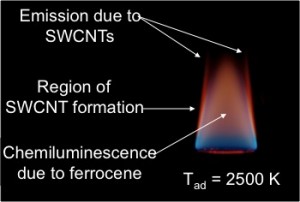
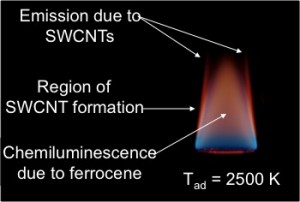
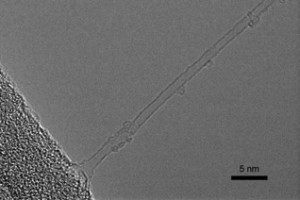
Our approach relies on Flame Design and the addition of silicon to produce clean SWNTs, as seen above. Also shown is a photograph of the flame used to produce the materials. The flame is a laminar inverse diffusion flame, in which ferrocene is used as the seed catalyst’s source of iron.